Einwechter Plumbing and Heating Inc. logo
Einwechter Plumbing & Heating
548-255-2662
Monday to Friday, 7am to 5pm
QR code to call Einwechter Plumbing & Heating, Kitchener-Waterloo
Scan with your phone camera to call

How does a heat pump water heater work? A plain-English guide.

A heat pump water heater, also called a hybrid water heater, works like a fridge in reverse: it pulls heat out of the air around it and moves that heat into the water in the tank. Here is how it works, what it needs in your basement, and when it is worth it in Ontario.

Heat pump water heater About 4x as efficient as a standard electric tank, by manufacturer ratings.
  • Diagrams of how it works and its modes
  • What your basement needs before you buy
  • Pros and cons, and the $500 Ontario rebate

New Dundee, Wilmot Township, Kitchener, Waterloo, Cambridge, Guelph, Milton, Halton Hills, Acton, Rockwood and Georgetown

How it works


It moves heat. It does not make it.

A regular electric tank heats water with elements, like a kettle. A heat pump water heater mostly moves heat that is already in the air around it into the water. That is why it uses so much less electricity.
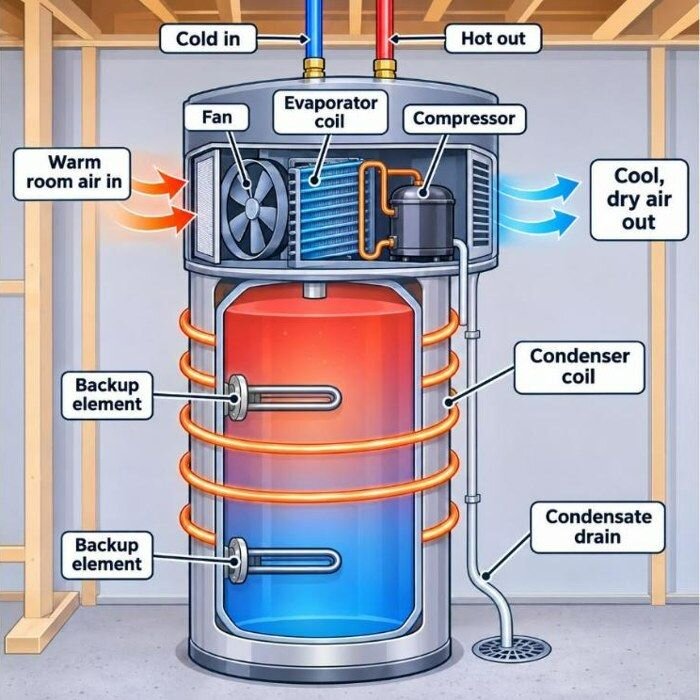
Illustration of how a heat pump water heater works: a fan pulls warm room air over an evaporator coil, a compressor heats the refrigerant, a condenser coil around the tank heats the water, and cool dry air leaves the unit.
Illustration: the parts of a heat pump (hybrid) water heater.
  1. A fan pulls in room air. The heat pump sits on top of the tank. Its fan draws basement air through a filter.
  2. The evaporator coil takes heat out of that air. Cold refrigerant in the coil soaks up heat, even from air that feels cool to you.
  3. The compressor makes it hotter. Squeezing the refrigerant raises its temperature well above the water temperature.
  4. The condenser coil warms the water. The hot refrigerant runs through a coil around the tank and passes its heat into the water.
  5. Cooler, drier air comes out. The air leaving the unit is a few degrees cooler and has less moisture. The water it pulls out runs down a small condensate line to a drain.
  6. Backup elements help when needed. Most models also have regular electric elements, so you still get hot water on a big demand day or if the room gets too cold.

The heat pump loop

Like a fridge, in reverse.

Your fridge takes heat out of the food and dumps it into your kitchen. A heat pump water heater does the same job the other way around: it takes heat out of the room air and dumps it into the water.

The refrigerant goes round and round the same sealed loop: it absorbs heat from the air, the compressor squeezes it hotter, it gives that heat to the water, and a valve lets it cool off so it can pick up more heat. Manufacturers rate these units at roughly 3.5 to 4 times the efficiency of a standard electric tank. For example, Rinnai lists its 50-gallon REHP at a UEF of 3.75, and a typical standard electric tank is about 0.93.
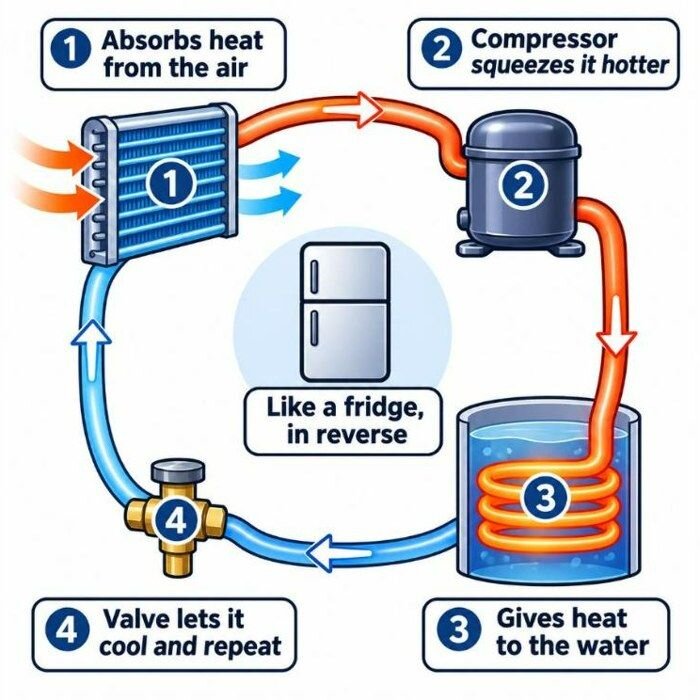
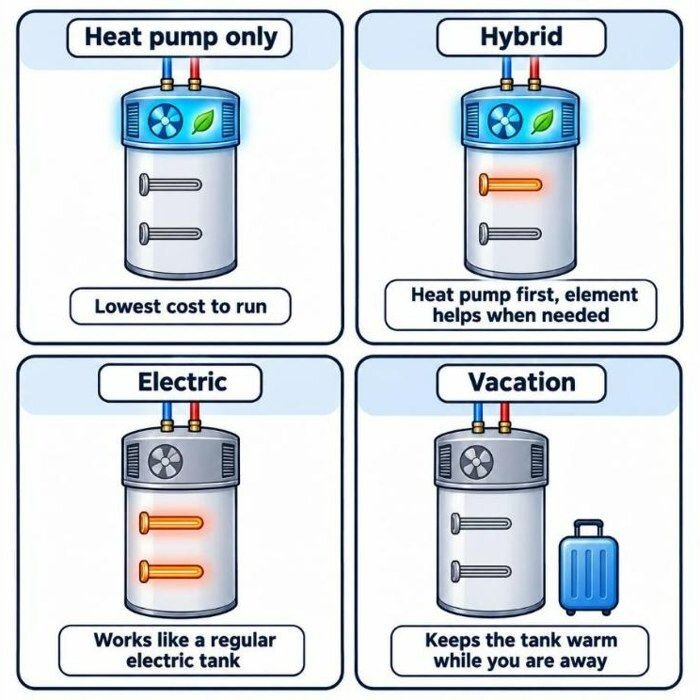
Illustration of the heat pump loop: absorb heat from the air, compressor makes it hotter, heat goes into the water, valve lets it cool and repeat.
Illustration: the four steps of the heat pump loop.
Illustration of heat pump water heater modes: heat pump only, hybrid, electric and vacation.
Illustration: the common operating modes. Names vary by brand.

Operating modes

You choose how it heats.

Most heat pump water heaters let you pick a mode on the control panel or in an app. The names change by brand, but they usually look like this:

  • Heat pump only (A.O. Smith calls it Efficiency): uses only the heat pump. Cheapest to run, but slower to recover after a lot of hot water use.
  • Hybrid: uses the heat pump first and turns on an element when you need hot water faster, or when the air or water is outside the heat pump's range. This is the usual setting.
  • Electric: works like a regular electric tank. Handy in the dead of winter if you do not want it pulling heat from your basement.
  • Vacation: holds the tank at a low temperature while you are away. A.O. Smith's Voltex holds 15.6°C (60°F) for up to 99 days.

What it needs

Not every basement is a fit.

A heat pump water heater needs a few things a regular tank does not. We check all of them before we quote.
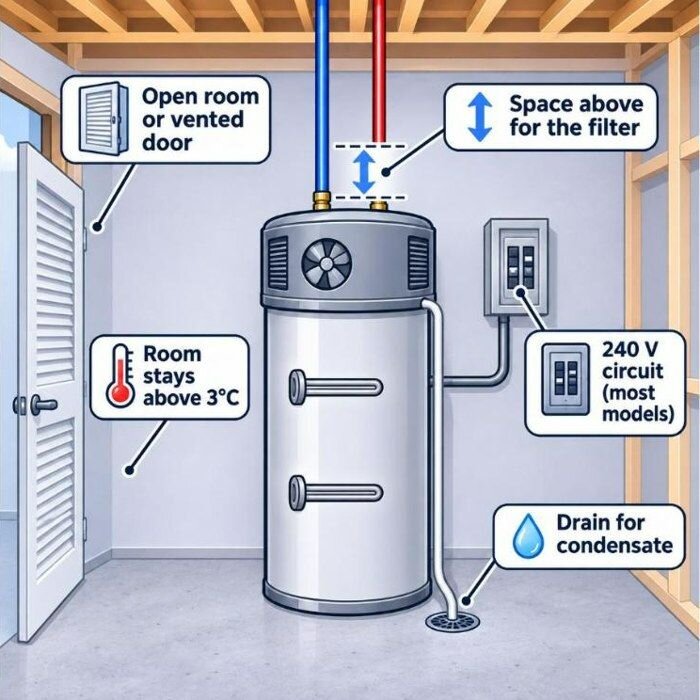
  • Enough air. Rheem asks for at least 700 cubic feet of air space, about a 10 by 10 foot room with a 7 foot ceiling. An open unfinished basement is ideal. In a small closet you need a louvered door or a duct kit.
  • A room that stays warm enough. Rinnai's heat pump runs down to about 3°C (37°F). Below that, the elements do the work.
  • A drain for the condensate, and a drain pan. The unit makes water as it dries the air. A floor drain nearby is easiest. If there is none, we add a condensate pump and run it to a drain. The tank also sits in a drain pan; Rinnai lists a missing drain pan as improper installation under its warranty.
  • Power. Most 50-gallon and larger models need a 240-volt, 30-amp circuit, the same as a regular electric tank. If you are replacing an electric tank, the wiring is already in place and we connect it. For a brand-new location, a licensed electrician runs the new circuit first.
  • Height and room for service. They are taller than most tanks. A.O. Smith's 50-gallon Voltex needs 63 inches of height, and Rheem asks for space above the unit to clean the filter.
Illustration of heat pump water heater installation needs: open room or vented door, room above 3 degrees C, condensate drain, 240 V circuit and space above for the filter.
Illustration: what we check before installing one.
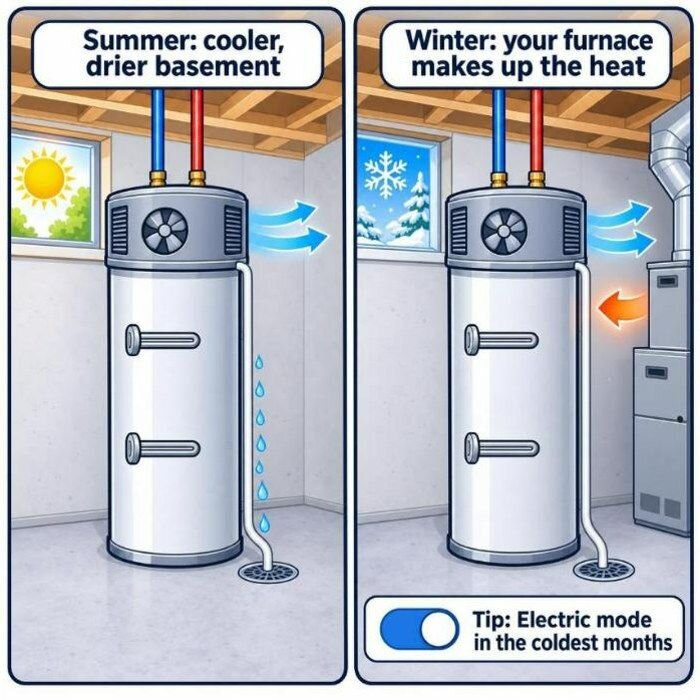
Illustration of a heat pump water heater in summer (cooler, drier basement) and winter (furnace makes up the heat; electric mode tip).
Illustration: the effect on your basement in summer and winter.

Your basement

It cools and dries the room around it.

Because it takes heat and moisture out of the air, a heat pump water heater works like a small dehumidifier and air conditioner for your basement.

  • Summer: a cooler, drier basement is a bonus. Many people can run their dehumidifier less.
  • Winter: the heat it takes from the basement has to be replaced by your furnace or boiler. In most finished or heated basements this is small, but you can switch to Electric mode in the coldest months, or duct the air to or from another space.
  • Noise: the fan and compressor make a steady hum while they run. Many owners compare it to a dehumidifier. Keep that in mind if the tank is next to a bedroom or office.

Is it worth it?


Heat pump water heater pros and cons in an Ontario home.

The honest answer depends on what you have now.

Usually a good fit

  • You are replacing an electric tank (owned or rented). The wiring is already there and this is where the savings are biggest.
  • You are building new or doing a big renovation and need a water heater where there was none.
  • Your home has no natural gas.
  • Your basement is damp and you run a dehumidifier.
  • You are cutting emissions or moving the house toward all-electric.
  • You have an open, unfinished basement with a floor drain.

Think twice

  • You have natural gas and are replacing a gas tank. We still recommend a power-vented gas tank here. Gas is usually the cheapest way to heat water in Ontario, and a 2017 Ontario study (TRCA's STEP program) found a heat pump water heater only beat gas on running cost at gas prices well above Ontario's.
  • The only spot is a small closet with no venting.
  • The tank would sit next to a bedroom.
  • Your basement gets very cold in winter.
  • Your family uses a lot of hot water in a short time and you would rather not use Hybrid mode.
 Heat pump (hybrid) tankRegular electric tankGas tank (power-vented)Tankless (gas)
How it heatsMoves heat from the air, elements as backupElectric elementsGas burnerGas burner, only when a tap is on
Electricity useAbout a quarter to a third of a regular electric tankHighestSmall (fan and controls)Small (fan and controls)
NeedsSpace, drain, 240 V (most models)240 VGas line, vent, outletGas line, vent, outlet
Hot water supplyTank; slower recovery on heat pump onlyTankTank, fast recoveryEndless, flow limited
Effect on the roomCools and dries itNoneNoneNone
Best forElectric homes, damp basementsLowest upfront costGas homes, simple swapGas homes, big families

Heat pump water heater prices: from $4,900 + HST installed, replacing an electric tank. See heat pump water heater installation. Comparing tankless? See tankless water heater installation. Prices for every option are on our water heater replacement cost page.

Brands

The main heat pump water heaters sold in Canada.

They all work the same basic way. The differences are size, efficiency, how quiet they are, app control and warranty.

  • Rinnai REHP: 50, 65 and 80 gallon, UEF up to 4.0, runs down to about 3°C. 10-year tank and 10-year parts warranty (1 year labour from Rinnai) when installed by a licensed contractor and maintained.
  • Coming soon: Rinnai REHPW. Rinnai's new heat pump series adds Wi-Fi, so you can check and control the water heater from your phone. Rinnai lists 50, 65 and 80 gallon sizes, UEF up to 4.0, five operating modes, a first-hour rating up to 91 gallons, a duct-ready design for tight spaces, and a 10-year tank and parts warranty. It is also built for utility demand-response programs (CTA-2045). Ask us about Canadian availability.
  • Rheem ProTerra: 40, 50, 65 and 80 gallon, UEF up to 4.07 on its 50-gallon model, 10-year warranty, with plug-in versions for some homes.
  • A.O. Smith Voltex (also sold under A.O. Smith's Canadian brands GSW and John Wood): 50, 66 and 80 gallon, four modes. 10-year tank and 10-year parts warranty.
  • Navien NWP500: 50, 65 and 80 gallon, stainless steel tank, UEF 3.85 on the 50-gallon, rated under 45 dBA.

Specs are from each maker's published Canadian brochures and buying guides and can change. We confirm the model, size and warranty in your written quote.

Rebate

Heat pump water heater rebate in Ontario.

Ontario's Home Renovation Savings program pays $500 for an ENERGY STAR certified heat pump water heater that replaces your existing water heater. It is part of a bundle, not a stand-alone rebate:

  1. Book a home energy assessment before any work starts.
  2. Pick at least two upgrades from the advisor's report. The heat pump water heater counts as one.
  3. Have the work done by a professional contractor.
  4. The same energy advisor does a follow-up assessment and sends in the paperwork.

Homes heated with natural gas must be Enbridge Gas customers. Homes heated with electricity, propane, oil or wood qualify through the electricity grid. The program also pays $600 toward the two assessments once the bundle is done. Rules change, so check homerenovationsavings.ca before you start, and see our plumbing and water rebates page.

Questions we get asked

Heat pump water heater FAQ

How does a heat pump water heater work?

A fan pulls room air over a cold coil, which absorbs the heat. A compressor makes that heat hotter, and a coil around the tank passes it into the water. Backup electric elements help when you use a lot of hot water at once.

Is a heat pump water heater the same as a hybrid water heater?

Yes. Most are sold as "hybrid" because they combine a heat pump with regular electric elements. The heat pump does most of the work and the elements help when needed.

Will a heat pump water heater work in a cold basement?

The heat pump needs the room above about 3°C (37°F) on most models. Below that it switches to its electric elements, so you still get hot water, just at regular electric cost.

Does it need a drain?

Yes. It pulls moisture out of the air, and that water has to go somewhere. A nearby floor drain is easiest. If there is none, we add a condensate pump and run it to a drain. A.O. Smith's spec sheet says a condensate pump is required when no suitable drain is available.

Do I need a new electrical circuit?

If you are replacing an electric tank, no: the 240-volt wiring is already there and we connect the new unit to it. If it is going in a new spot, or replacing a gas tank, a licensed electrician needs to run a new 240-volt, 30-amp circuit first.

Will it make my basement cold?

It cools the air around it by a few degrees while it runs and dries it out. In summer that is a bonus. In winter your furnace or boiler makes up the heat, or you can switch the unit to Electric mode for the coldest months.

Should I replace my gas water heater with a heat pump water heater?

Usually not. If you have natural gas, we still recommend a power-vented gas tank to replace a gas tank, because gas is usually the cheapest way to heat water in Ontario. A heat pump water heater is a good choice when you are replacing an electric tank, or putting in a water heater where there was none before, like a new build or a big renovation.

Heat pump water heater or tankless?

A gas tankless gives endless hot water and suits gas homes with big hot water use. A heat pump water heater suits electric homes and basements with room and a drain. See the comparison table on this page, or ask us to look at your space.

Is there a rebate for a heat pump water heater in Ontario?

Yes, $500 through Home Renovation Savings, but only as part of a bundle with a home energy assessment and at least one other upgrade. Homes heated with natural gas must be Enbridge Gas customers.

What warranty comes with a heat pump water heater?

Rinnai and A.O. Smith both cover the tank and the parts for 10 years. Rinnai's warranty needs a licensed installer, regular maintenance and a drain pan under the unit. Labour coverage from the manufacturer is shorter, so ask us about our labour warranty.

Heat pump water heaters

Tired of a wet basement?Let's fix the reason.

See our heat pump water heater installation prices, or call or book a visit. We look at your space, drain and power, tell you honestly whether a heat pump water heater makes sense, and give you one written price before we start.